Episode Summary
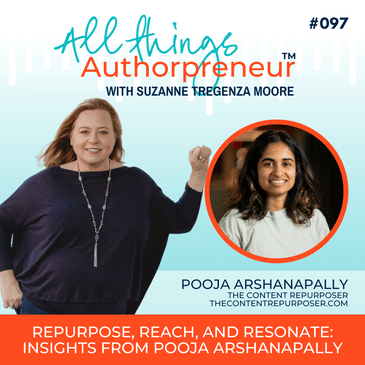
Pooja shares her journey of becoming a content repurposing expert and how her innovative strategies are revolutionizing the way authors connect with their audiences. With her warm and engaging personality, Pooja delves into practical tips on how to effectively repurpose book content into blogs, podcasts, social media posts, and more, ensuring that every author's message resonates far and wide.
Guest
Pooja Arshanpally | The Content Repurposer
thecontentrepurposer.com
Highlights
In this episode you will learn:
- Pooja's beginnings, the story behind the journey of being a content repurposing expert.
- How content repurposing works and the benefits that comes along with it.
- Pooja's AHA moment that pushed here to where she is now.
Book
Perfectly I'Mperfect: Remarkable Stories of Ordinary Women overcoming Extraordinary Circumstances
Free Gift
3 Ways to Repurpose Your Book Into Social Media Content
Recommendation for Every Entrepreneur
Never give up and have patience.
Favorite Book
Links in this summary may be affiliate links.
[00:00:00] .
[00:01:03] How it would just be so valuable for particularly nonfiction authors. Welcome and looking forward to this conversation. Yeah, of course. Thank you for having me on. And yeah, I was it was definitely a unique proposition or type of service that I offer.
[00:01:20] But eventually explain how I got to that point of like of that specific service. Yeah. So like tell me like a little bit about your entrepreneurial journey. Right. Yeah. So before I even started like my own business, I originally started in tech
[00:01:36] and I was doing a lot of like coding apps. And for me, I think I was just like over the job that I wanted or I had. Yeah, I think you I outgrew my job. So I think that was it. And I wanted something different.
[00:01:52] I always wanted to be an entrepreneur or wanted to have my own business, but I didn't really know what I wanted to do. So like on the side, I was just working different types of jobs. Just trying to figure it out.
[00:02:04] And I worked with someone who did marketing and she did all the marketing campaigns for different clients of hers. So she just needed someone to outsource the social media work. So I took on some of the work for her.
[00:02:17] And for me, I actually liked her job versus mine. So that's kind of how I started. And I went into more of social media marketing and like content creation. Yeah, first. But then I realized I felt like I was only scratching the surface
[00:02:31] with what I could help with people. And I wanted to do more for me. I was trying to figure out where to focus on. So I really liked books. I liked education. And I knew that as when I was talking with a lot of authors,
[00:02:46] they were in need of social media worker, different things like that. And I realized it wasn't just social media. It was like all aspects of marketing. They were trying to figure out. And after like talking with a lot of authors,
[00:02:58] they just didn't know what to do with the book after it's been published. And that was the hardest thing is knowing what to do and how to be consistent with it. Yes, I can see that because, you know,
[00:03:09] I think anyone who's creating content and to support their business on a regular basis, I know that one of the things I hear often from my clients, like for years, I would hear people say, well, if I wrote a blog post,
[00:03:22] can I use that same thing in my newsletter? And I was like, yes, you can use the same thing in your newsletter. You can use it on your social media. You can, you know. So I think like if you're an author, it just gets expanded.
[00:03:36] Right. Well, I already wrote the book. People can read the book. Why would I shouldn't use that for all my social media? Right. Because that's like cheating. Right. And it's like, no, it's not cheating. It's using the message that you're trying to amplify to amplify it. Right.
[00:03:54] So it's so interesting. Like, I think we get caught in this mental game of I have all of this resource, right. I.E. the book that I wrote. But somehow I'm not supposed to use that. I'm supposed to come up with more original stuff all the time.
[00:04:09] And what you're really saying is, no, let me help you take your book and use it in all kinds of different ways. Right. Yeah. So you do that not just in social media. It's also like email marketing, blogging, things like that. Talk a little bit more about that.
[00:04:27] So I would say like I've worked with I focus more on like podcasts. I've done like course material for people or they wanted to do like I've helped an author create a book into like a retreat. And like she had to have a four day retreat
[00:04:42] where she was using the book as like talking material. So it was kind of giving her a course like the different teaching materials. She have a strategy presentation. So it's just like all of that.
[00:04:53] So it's just like eliminating a lot of the work that she was already going to do. Right. And just providing it for her, because I think a lot of people they want once they publish the book, they want direct sales.
[00:05:04] And that's they want to make up the money that they paid for. Agreed. And it is a huge like it is a huge cost. And I think that I think sometimes it's like you're not thinking like if you're thinking of like, oh, my God, it's so much money
[00:05:17] and you're not thinking like what you what else you can do with it or just expanding the ways that you can use it. Yes, because I know a lot of people like especially in the nonfiction route,
[00:05:28] they use the book as like a sales tool to to access higher education. So are higher paying services. So it's kind of like, but like why gatekeep the ideas in the book? You know, yes, absolutely. So why not just disperse it?
[00:05:42] Because I don't think because like because you have a book, it doesn't mean that people are going to read it. And not everyone likes reading. So you can easily put that into a podcast and people would be able to resonate with that.
[00:05:54] Yes, getting people at a broader audience, but having the same ideas and content. Yes, I totally agree. And, you know, this goes back to another thing that I've heard from clients for years, right?
[00:06:06] And the whole idea of a free gift and I don't want to give everything away. Right. And you shouldn't give everything away. Right. But I mean, how many of us have read a book thought, wow, that is such like that's profound. Right.
[00:06:22] And done absolutely nothing with the knowledge that we have received from reading that book. I know I could raise my hand on that. I'm sure you could. Right. There is not a person listening that hasn't read a book been like, I should do that and then hasn't. Right.
[00:06:38] So it is OK to put it all out there in the book because putting it all out there in the book, the number of people that will actually read the book and take the action and achieve what they can achieve to the maximum is very, very, very small.
[00:06:56] The reality is, is that people need more support than that. They need to hear things multiple times in multiple ways. Some of that might be through a regular podcast. Some of that might be through blog articles.
[00:07:09] Some of that might be through a course or an event or whatever it might be. And it is the comprehensive ability to communicate the information that's in the book and that is your expertise that really sets you apart from someone else and puts you in the place
[00:07:27] where you can call yourself a thought leader. And, you know, people actually think that you're genuine. Right. Right. And I also think like I kind of give this analogy of like if someone is driving and they only know one direction to get to one place,
[00:07:42] it kind of limits their like anything could happen. It's like there could be a flood. Someone could flood the road or there could be construction. So it's it's good to have different paths to the same type of direction. That is so true. Absolutely. I love that analogy.
[00:07:57] It's fantastic. So what really made you say, you know what? I'm going to niche down to working with authors. What was the like, was there a sort of aha moment or a catalyst to have you niche down or did it just kind of happen gradually and organically?
[00:08:16] I think it's more like just testing out. It wasn't really like a profound impact or something that just made me want to do it. It was more of like, I think that this might be a good idea.
[00:08:27] Let me just test it and see if it works or not. Yeah, sure. And let me just hone in on it and just see if there's something there. Mm hmm. Yeah, awesome. So I think when you provided all your information,
[00:08:41] you shared a free gift that you might have for people to kind of get a flavor of what you do or get to know you a little bit more. Do you want to share what that is?
[00:08:50] And I will tell everyone right now that she might tell you the URL, but we'll make sure that it's also in the show notes so you don't have to write it down if you're driving or something. Right.
[00:08:59] So I have it's just a free PDF where I talk about three different like authors who have been like how they were able to repurpose their content and be able to access new opportunities by being able to to go into different mediums.
[00:09:15] I love that. I love that because, you know what? Honestly, like we were talking and you said, oh, well, I helped this author create a four day event from her book that when I read that you are repurposer, that never had entered my mind.
[00:09:30] So I'm curious to see what those case studies are about and how people used it, because I know it'll get the sort of energetic juices flowing in terms of what all can be done. Right. Yeah. Very cool.
[00:09:44] All right. So we'll, as I said, make sure that that's in the show notes for you guys to access you listeners. So there are a few questions that I ask everyone who comes on Pooja. And the first one is so you work with authors now
[00:09:58] do you think you'll write your own book? Yeah, I want to write my own book. I actually am a part of anthology. It's called Perfectly Imperfect. Love it. Yeah, I will send a link. I can send you a link to the book.
[00:10:12] There's just a lot of books that with the same titles. So I just want to make sure that everyone who searches it knows exactly the book it is. It's just like an anthology and my chapter is more about how I was. Well, I am an introvert,
[00:10:26] but I think it was more of like the misconceptions that people had about being an introvert. So and how I overcame that. I love that I as an extreme extrovert myself, it's taken me a long time to sort of understand introverts and especially in the realm of entrepreneurship,
[00:10:47] because I mean, the way we all show up in different ways. Right. But as someone who's like a real extrovert, I show up very differently than people who are real introverts. But we both have a lot of value to bring to every situation.
[00:11:02] So I love that. That's what your chapter is about. Terrific. And you think you might write your own book at some point as well? Yeah. Yeah, awesome. So another question I ask everyone who comes on is what is one thing because you're an entrepreneur now.
[00:11:18] You left that coding job. What is one thing that you think every entrepreneur needs to do or have in order to be successful? I think it I know this is it's kind of like maybe it's said, but it's kind of just not giving up and just being patient,
[00:11:36] which I would say that I am a pretty patient person, but you need a lot of patience and you kind of have to make decisions knowing like not knowing whether or not you've made a good one. And you just kind of have to just be confident
[00:11:49] in those decisions regardless if it's wrong or right. I love that. And I especially love it because the reality is, is that decisions are made. And once they're made, you can make them most of the time.
[00:12:02] You can make them right even if they were a little bit squishy to begin with. Right. Yeah. Yeah. So I love that. And especially in business. And you know what? We do sometimes make decisions that they were definitely wrong.
[00:12:16] There is not a way to to fix them, to bring them around. But then they become learning experiences and taking our learning experiences and moving forward is always beneficial to our businesses. So love that last question I ask everyone who comes on is what is your favorite book?
[00:12:35] That's a hard question because there's so many books. I would say, OK, so for like business wise, I would say Daniel Priestley, key person of influence. That book is really good. And for me, I think my personal preference is when books are so easy to read.
[00:12:53] They're like easily digestible. Yes, because he talks about high level concepts, but he explains it so well that like anyone could understand. Love that. Yes. It's really important to keep the jargon down and make your book extremely readable when you're writing.
[00:13:12] And if that is what he did in that book, then definitely sounds like a good one to read. Well, Pooja, it has been a delight to have you on the show and to talk about repurposing the content in nonfiction books.
[00:13:27] I think that the service you provide is really fabulous. And as I said at the top, something that many, many people, if not everyone who listens to this podcast, would get a lot of value from. So thank you for taking the time to speak with me today.
[00:13:42] Yeah, of course. And thank you for having me on. Absolutely. And to everyone listening, I will bring you another episode of All Things Authorpreneur very soon. Thank you for listening to All Things Authorpreneur. Head to all things authorpreneur.com and get your free guide
[00:14:01] Seven Success Principles to Shift from Author to Thought Leader.