
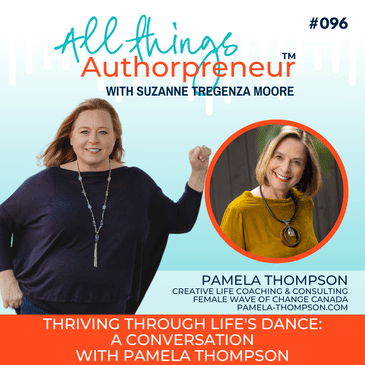
Episode Summary
In this enlightening episode, Suzanne Tregenza Moore interviews Pamela Thompson, an expert in navigating life transitions and leading in uncertain times. Pamela has lived and worked on five continents, experienced significant life changes, and emerged stronger and wiser. She is the founder of Female Wave of Change Canada and the author of two insightful books: Learning to Dance with Life: A Guide for High Achieving Women and The Exploits of Minerva: Reflections of a Sixty-Something Woman. Join us as Pamela shares her journey, valuable insights, and actionable strategies for thriving through life's changes.
Guest
Pamela Thompson | President & Founder
Creative Life Coaching & Consulting and Female Wave of Change Canada
pamela-thompson.com
Highlights
In this episode:
- Pamela shares her life journey as a high achieving woman experienced in burn-out and recovery.
- What her daily life working in Afghanistan was like and how the relationships she built there are influencing her future writing.
- How to recognize and embrace your own life transitions.
Book
Learning to Dance with Life: A Guide for High Achieving Women
The Exploits of Minerva: Reflections of a Sixty-Something Woman
Free Gift
Recommendation for Every Entrepreneur
Entrepreneurs should take the time to go inside and ask themselves, "Is this what I want to be doing right now? And if it is, then what's my next best step?"
Favorite Book
The Phone Booth at the Edge of the World by Laura Imai Messina
Links in this summary may be affiliate links.
[00:00:00] .
[00:01:32] I'm so excited to have you here today. Thank you. Well, thank you so much, Suzanne. I'm excited to be here, and I appreciate the opportunity. Absolutely. So I want to start off just talking about all of the changes that you've had in
[00:01:51] your life and how you were inspired to write about them. Just the fact that you've lived on five continents alone, like there are not that many people that can genuinely think and Lee say that, maybe traveled to five continents, but lived on five continents.
[00:02:08] So let's get started there and just talk about what your life has been and how that came about. Well, I knew from a very young age, Suzanne, probably from about age four, that I was going to travel the world and be of service in some way.
[00:02:25] I didn't know what that would look like, but I could feel it in my bones. I've always been interested in different people, countries and cultures from a very young age. And I ended up doing a little bit of consulting, doing international stuff.
[00:02:39] But my ex-husband, he traveled around the world and was gone about six months of the year. So I felt I had to maintain the roots for the family. So I did not travel with him many times, only for shorter jaunts, if you
[00:02:52] will. And so it wasn't until our son was 17 or daughter was 19 that I really got to do the international work and really travel extensively. And I've had four consulting and coaching businesses since the early 90s. And during that journey, I had the opportunity to work with an amazing
[00:03:14] consulting group and we managed and consulted on international development projects in a variety of sectors around the world. So I managed and consulted on a big HIV surveillance project in Pakistan. And I also led the design team and the front end implementation of a primary
[00:03:29] health care project in Nigeria. Then when I was off on my own, doing my own thing after I left them, I ended up getting an email inviting me to throw my head into the ring for one of four positions in Afghanistan.
[00:03:43] And one of them had my name written all over it. And it was Senior Technical Advisor, Strategic Planning and Performance Measurement, which was one of my things that I used to do. So I ended up getting that contract and living and working in Kabul, Afghanistan for 13 months.
[00:03:59] So it's like I'm one of these people as well that working for someone else, my average length of time was three years. And then I would say, OK, I think I've got it now. I've learned as much as I can here next.
[00:04:14] And then some amazing opportunity would usually present itself. That was usually what happened. Or sometimes I would say, OK, now I want to move from domestic to international consulting. Who do I know? Talk to my network, invite someone up for lunch,
[00:04:27] ask for their insights and then then do what they suggested. And yeah, it enabled me. It has enabled me to do amazing things, I believe, in the world and to have amazing opportunities come to me. That said, I always felt I wanted them.
[00:04:43] And I would always go into my heart and got to say, is this really what my next step is? Yeah, I know. You know, it wasn't all cognitive. It was really, OK, I'm ready now to take something on.
[00:04:55] And then something would come as, OK, is this it? Right. Yes. You made sure you were emotionally ready for the task at hand and that your inner wisdom was saying, yes, you really are ready before you move forward. Yeah, I love that.
[00:05:09] I have to say of everything you just said, I mean, there were so many wonderful nuggets. But I think the thing that at least I personally relate to the most is that you were home, you know, managing the family until such time as your children were 17 and 19.
[00:05:25] And then you went on this adventure, if you will. And I think that's inspiring from the standpoint of there are so many women who get to the point where their kids are 17 and 19, and they feel like they either they are in a place
[00:05:41] where they don't know what they want or how to move forward. Or it's like they've been waiting for that time because they've made the choice to put their family first. And now they get the opportunity to really spread their wings and do what they want.
[00:05:56] So I find it inspirational that you got to that point and you really spread your wings and flew clearly in very interesting paths. And thanks so much, Suzanne, for that. And I just want to say that throughout those years
[00:06:11] where I was largely at home and didn't travel that much, I still did some had some amazing consulting work on my own, was an academic and was able to do some really neat things in Canada largely. Yeah, no, absolutely.
[00:06:25] But I don't know at what age you were when you had that transition point. But I guarantee it was an age that some people feel they can't start something new or that drastically different. And it's wonderful to see and to have someone inspire people to do so. Right.
[00:06:46] Well, thank you. I appreciate that. Absolutely. Yeah. So you said you were in Kabul for 13 months. I mean, I think that anyone who has worked there during a period of time where Americans were there or Canadians or and has seen what has happened, it's very traumatic.
[00:07:05] Can you share your thoughts on that with the audience and what your experience has been of that? That's it. That's a big, big question. Yeah. I just want to say that living and working in Afghanistan was life changing for me.
[00:07:21] I was there from mid October 2010 till mid November 2011 and then backstopped for six months virtually and went back again for a short mission in 2015. That said, when I was there for that 13 months, it was a war zone. Like, you know, it's like there were IEDs.
[00:07:38] The American embassy was attacked when I was there. And as we were right in the Ministry of Public Health, I was working with was right beside COLA was right beside. Oh, my goodness. I was going in into the grounds of the ministry. I was not there.
[00:07:52] I was facilitating a national workshop with my strap planning team at the time. But yes, this sort of stuff. So it was like stuff was always happening. And we had security guys who were in who were part of a British security group.
[00:08:06] And they were they were train our our drivers and guards to use guns because they would how I went to work. Suzanne was the for the first nine months was in a convoy. I was in a bulletproof vehicle with an armed Afghan driver.
[00:08:24] And then behind us was a soft skin. So a notable vehicle with three guys with AK-47s. That's why I moved to the streets of Kabul. Yeah, yeah. And so anyway, so it was really something. And from the get go and in one of my interviews,
[00:08:40] I was asked how would I cope with being in a war zone? And I and I said, well, I had worked in restricted environments because Pakistan when I was there was quite restricted. And I said, you know, I told them I did yoga. I meditate daily.
[00:08:56] And I talked about that and that those practices really helped me when I was there. Plus, I would Skype at the time with with my partner. And he would, you know, almost every morning. And so we I would connect with with home, if you will.
[00:09:13] Was really, really helpful to do that. The people I guess I wanted to share that the people in Afghanistan who I worked with, it was like, I don't know whether you've ever seen that movie and I was I block on the woman's name.
[00:09:26] She plays a journalist and it's about living and working in Afghanistan. And when I saw that movie, it was like it's that's the way it is. Like you get to know the people there and they come from all sorts of backgrounds.
[00:09:39] A lot of Americans, a lot of Canadians, a lot of European consultants. And they have like really interesting lives. And some of them have been in war zones for a long time. And so asking them what triggered them the first time to do it.
[00:09:49] Often it was a divorce. It was like something that they made a major life change. And I said, what the heck? I'm going to do this now. Right. And it was so exciting because you're it's like such a challenge. You're like you're not only living in this environment
[00:10:04] that's incredibly uncertain, but you're also initially thinking, OK, well, these techniques that I've used in Canada work in this country. You know, I facilitated in nine months the development using participatory processes of the first strategic plan for the Ministry of Public Health in Afghanistan.
[00:10:21] And build the capacity of internal teams to do strategic and operational planning. So it's like I got to know the people and they just I just really feel I have so much sadness now for what's gone on
[00:10:33] and that I have light as well because several of the women, two sisters and their other sister emigrated as refugees to Canada. And I've been to see them twice. They live in the eastern part of Canada. Nice other men and his family.
[00:10:47] I was able to through the support of friends and family, raise money to get them out of Afghanistan and help him resettle in Canada. So I still have connections and I still, you know, recently did communicate with someone in Afghanistan and he didn't say too much.
[00:11:03] But he did tell me what it's like to live there now. Yeah, very, very sad. So I feel very close to the people and I feel I really feel for what's happening now. And I really hope the international community does step up
[00:11:17] and not forget all about Afghanistan. Yeah. Yeah. Thank you for sharing that. It's a unique perspective. I don't get to, you know, chat with too many people who've spent time in Afghanistan and and have that perspective. So I appreciate you sharing it with everyone.
[00:11:32] I want to talk a bit specifically about your books. So please, I would love just a little description of each of them and how they I'll say came into being. Well, thank you. The first one I watched in August of 2015,
[00:11:47] and that's the one called Learning to Dance with Life, a guide for high achieving women. And that actually came out of me, if you will, burning out after this this stint of working in Afghanistan, having just six weeks off
[00:11:59] and then taking on a contract with an international nonprofit that promotes women's and children's rights around the world. And then basically burning out after that and saying no to a contract to move forward, spending about five months in a process of studying mindfulness,
[00:12:17] reconnecting with family and friends, sleeping, singing national praises and then attending transformational author experience by Christine Closer that was virtual. It's like I got off that 10 day experience and it was like all these puzzle pieces of my life came together. And I'm like, oh, my goodness.
[00:12:34] And that's when I got, if you will, the download of the seven keys to what I call creative living, seven keys to consciously cultivating improved health, happiness, fulfillment and inner peace in your life. So then I started to do I launched a group
[00:12:49] coaching programs called Staying Healthy in Body, Mind and Spirit While Living Your Passion. And through that program, I tried out and created different exercises and questions and they're woven throughout this book. So it has coaching questions and exercises in it.
[00:13:04] And it also has tools and strategies that I myself have used and with high achieving women clients who I've coached to really recover, if you will, from burnout or prevent burnout and create lives because lives of increased health, happiness, fulfillment and inner peace. So that's the first book.
[00:13:24] OK, so before you go to the second one to say, I love the fact that you talked about that you took the five months off. Right. So many of us, it's like, oh, well, we just did this big project. And now we're doing another big project.
[00:13:39] And what's the next big project and the next big project? We don't recognize the desperate need to have some downtime. It's amazing to me. And again, it's so enlightening. It shouldn't be right. It shouldn't be enlightening that someone who went through
[00:13:58] a very intense experience then took five months off. Right. That should be like the norm. Don't you think? Yeah. And at the same time, I totally get that it's scary because if you're a consultant,
[00:14:11] then that's how you earn your living to say no to a contract and say sorry. And they'll say they said to me, the VPN director, you know, I've been working with, they said, Pam, why? Why are you turning down this part time because they reduce it
[00:14:23] to part time and narrowed the scope. I said because I want to create more balance in my life in 2013. And they said to me and I said, and that time and I said and I had no idea what that meant, but I knew in my gut,
[00:14:35] I slept on the decision. I almost signed and I always I would say to people, always sleep on sleep on your major life decisions. Yes. Lapt on the decision and I woke up and I felt like a lemon that had been squeezed dry.
[00:14:46] And I knew in that moment I had to say no. I had some time off and look after myself because otherwise you would have been thoroughly burned out. Really, really. Yeah, right. And probably wouldn't have given done your best work anyway,
[00:15:00] or you would have done it at the expense of yourself. Totally. Yeah. Yeah. OK. So now tell us about Minerva. Yes, Minerva. Well, the exploits of Minerva reflections of a 60 something woman. It's interesting. I'll briefly say her essence came to me when I was driving on a bike
[00:15:18] path about 30 years ago when I lived in Ottawa and I pushed her down. I said, no, no, I can't write about you now because I'm too busy launching my you know, my kids are preteens and I'm too busy launching my consulting business.
[00:15:30] And at the time it was really kind of interesting because I was the PR person, a volunteer position on the board of the Ottawa Independent Writers. So I was starting to dip my toe into doing creative writing because I was being paid to write program policy documents.
[00:15:45] But this was the creative piece. But I like, no, no, no, I can't do that. So anyway, so lo and behold, I'm going to say about five years ago, I decided four or five years ago, I decided, OK, it's time to write my memoir.
[00:15:57] And so I even went on a conference with Joan Boroshenko in Northern California to learn about the spiritual art of memoir. I think that when I was there and I came back, I'm like, no, no, no.
[00:16:08] Minerva came back and she said, no, you have to write about me now. And she came very insistent, apparently very insistent. And so it was really fun to write this book, Suzanne. Not to say it wasn't fun to write the other one, but it was
[00:16:20] more fun in terms of being playful to write the exploits of Neuro. She came to me and she's basically partly autobiographical, but partly this really playful, sensitive essence. And I've been doing work, as you know, in the change transition space for a number of years.
[00:16:38] And I created a five step art of change framework underpinned by the belief that embracing change is a creative process that opens you up to new possibilities on the metaphor. Life is a dance. So I can continue through with that dance metaphor.
[00:16:51] And I also have one of those seven keys in my first book is learning from and embrace life transitions. So part of this, really this this work that stemmed from this playful essence was to really share a number of reflections of my own life
[00:17:06] transitions I went through, but also other women that I knew who had gone through similar or different ones. I interviewed friends and friends of friends and then created composite characters. So it's really fun because I'm a qualitative researcher.
[00:17:20] I love to interview people and roll that up and then to do that and then to then put them in a women's circle. So it's about six women who've been part of a women's circle for over 20 years, supporting each other through a variety of life transitions.
[00:17:34] So part of it's autobiographical, part of it's real and part of it isn't. Do you know what I'm saying? Part of it's it's made up, but it was really, really fun. And it contains some of the aspects of my art of change framework as well.
[00:17:45] Totally. That sounds like a lot of fun. That sounds like a super fun book to write. And I love the fact that you took composites of different people to create the characters. It's so interesting that you say you're was it a composite researcher?
[00:18:02] Is that the word you used? Composite characters. Sorry, composite characters. But you said you like to do so much research and really do interviews and pull all that together. And I was like, oh, wow, I would be horrible at that. Everyone has their strengths. Yes, everyone does.
[00:18:19] Everyone does. That's right. Anyhow, it sounds like a super amazing experience. And I I love the fact that Minerva introduced herself to you long ago and was very persistent in coming back and saying, no, we've got to do this.
[00:18:39] Because again, there are so many things in life that we think about. And then they get shelved for a variety of reasons. And it's great when they come back up and, you know, jump into the world. Right? So true. Yeah. Yeah.
[00:18:54] So you also said that you're writing another book. So tell us about that. Well, I opened up space because I am going through yet. I'm I'm somebody who lives this work all the time. I have another transition having given up the leadership,
[00:19:09] a female wave of change, Canada, a nonprofit I founded in December of 2020. And it was a labor of love. And I gave it up to an amazing board and two amazing leaders who have taken it over that said where I am now in terms of
[00:19:24] I've opened up space to write that third book. It's going to be an historical fiction novel with Afghanistan as the backdrop. Yes. And so I'm really doing, you know, I'm thinking about it. I initially did a brain dump of all my peak experiences
[00:19:38] that I had in Afghanistan and then wrote that out, because I may have a character similar to myself in the book who comes in to consult from away because that's a different perspective. I'm not sure. Yeah, that's when starting. I'm reading more about the history of Afghanistan.
[00:19:54] So I have a better understanding. And then I feel like I know the the epic, if you will, or the timing, the time frame where I'm going to start it, set it. And I think I'm going to interview people that I know,
[00:20:09] Afghan women and men that I know, and then maybe create concepts that characters again, because I really enjoyed that experience. And then you get real stories. Right. It's not totally made up. It's like real stories. Right. Yeah. What was Afghanistan like?
[00:20:22] Did you know that women wore mini skirts in Afghanistan in the 1970s? Did you know that? I absolutely did not know that. Well, see, this is the thing. So my aim is to dispel a lot of myths about Afghanistan, also about Islam and with Muslim men,
[00:20:40] because I have been the boss of Muslim women in a few countries. And they're amazing people. And they, you know, there's a lot of there's extremes in all religions. And we can't sort of say all it's like all Christians are not the same,
[00:20:56] just like all Muslims are not the same. Right. Well, and all of anything are not good. And all of anything are not bad. And totally, totally. Everything has a spectrum. Right. And so this is what I really want to dispel some myths and the truth
[00:21:12] and a real lived experience of people. Yeah. I love the fact that you're jumping genres. Right. You're you're going from complete nonfiction. And then you're I mean, it sounds like your Minerva's story was almost like a bridge between. You said it was a little autobiographical, but not necessarily,
[00:21:34] you know, not completely. And then you're moving into fiction. I think that's fantastic. Good for you. Well, you know, lots of learning to, of course, I join. I'm learning more about how to write good historical fiction. So that's part of the process. Yeah. I love to learn.
[00:21:48] You know, I really believe that one of the reasons that entrepreneurs are entrepreneurs is because they love to learn. I don't know any entrepreneurs that don't love to learn. Do you? That's a very good point. I haven't really thought about it, but really,
[00:22:03] because if you don't learn, you won't stay in business very long. No continual experiment. Try this doesn't work. Try something else does work. And it's deadly if you don't change it up. You can be absolutely for years and getting no R.O.Y. Just the same thing.
[00:22:17] Yes. And people do. Oh, they do. Oh, been there done that. Yeah, exactly. Me too. Me too. Over it. Yeah. But absolutely. That's so true. Yeah. So I want to talk a little bit about really the feminine leadership.
[00:22:33] I mean, you just were saying you you led Afghan men, right? When you were in some of the people you were leading were Afghan men. But wherever you go, being a female in a leadership role can be challenging.
[00:22:48] What do you think are the things that you've drawn on the most to achieve success in feminine leadership? And what am I not asking you about about your experience of leadership that I should be? OK, the first part of the question. You know what?
[00:23:07] I'd rather frame it as what are the learnings and the lessons just great. Please do. Because I feel if you're OK with that, what I feel like is there's a bit of mythology, I believe, about women and men, but also about working in different cultures.
[00:23:24] It's like people go in and think, oh, I need to know all these things about culture so I don't make a major faux pas, right? You know what? What I know to be true is if you come from your heart
[00:23:33] and you respect people, if you respect people and yes, you're going to you know, you're not going to wear low cut tops in a Muslim country. You're going to scare back their cultural values. Yeah. You don't have to act like you're like Mr. Mirror and whatever.
[00:23:48] So if you're authentic, if you respect people, you make them feel like they belong. You ask for their input always. I'm a collaborative leader and from female wave of change, which is a global social movement started by an amazing woman
[00:24:02] called Inge Boel seven and a half years ago in the Netherlands. And we're now in over 40 countries. We believe that feminine leadership, which includes, you know, qualities like creativity, collaboration, emotional intelligence, intuition, that they all hold the key to creating a better world
[00:24:20] and have these qualities and can have them and learn them. However, they are associated with the feminine. So if we truly stand in our power as people, we are authentic. We come from our hearts. We are open. We listen instead of judging.
[00:24:35] And I'm you know, I can judge people too. I'm not I'm far from perfect. However, I'm really trying to work on this bit about I think I'm better actually in other countries and cultures than with people in my personal life sometimes. But interesting.
[00:24:49] Yeah, it's like instead of judging, be curious. Like why did they do that? Isn't that interesting rather than saying, oh, my goodness, they do that. What the goodness don't they know better? Yeah, right. Because you're curious. People get that.
[00:25:03] And also, I'm very hard working, probably too hard working. But, you know, in these international environments, you work in sometimes 12, 15 hours a day. It's like crazy because stuff comes up, you do it and then something else pops up. Oh, well, I got to do that.
[00:25:16] I'm going to do something else. Well, sorry. It's like anyway, it's yeah, it's it's I really feel that the world would be such a better place if we all believe, realize that we're really all the same. Yeah. And love will be respected, loved,
[00:25:32] feel like we belong and we a lot of us belong and believe in family. You know, if we all were curious and came from those those perspectives, then we wouldn't have wars. Right. We'd be learning from one another and focusing on stuff related to the planet
[00:25:49] like the bloody world's falling apart. You know, yeah, the systemic racism, all these big things. Let's get out of our holes here and get up and say, OK, what can we do to help the planet? Yes. About all these squabbles with us and the differences.
[00:26:03] Focus on the sameness. There's so much to think across the different human races. So much the same. Absolutely. Yeah, yeah. And being wanting to be respected and loved and treated with kindness. And that is true. I don't know anyone who doesn't want those things. Beautiful.
[00:26:20] So there are a couple of questions I ask everyone who comes on the podcast. And we've already talked about one, which is, do you think you'll write another book? Check. We know guys, we know she's writing another book.
[00:26:33] Another is, what is one thing you believe every entrepreneur needs to do or have in order to be successful? You know what? I feel like all entrepreneurs need to take time to go inside and really ask themselves, is this what I want to be doing right now?
[00:26:56] And if it is, then what's my best next step? Mm, I love that. Yes. Yes. I have asked myself that question many times when I feel I'm at a crossroads or I'm unsure of myself just really getting centered and saying, what is my next best step?
[00:27:15] You can only take one step at a time. Very true. But if you really sort of center yourself and let the noise go, you can always decide what the next best step is. I love that. Fabulous. Last question. What is your favorite book?
[00:27:34] That's a tough one because I read a lot of books. I am in a book club as well. I really enjoyed The Phone Booth at the Edge of the World. Oh, interesting. OK. It's written by a Japanese author, and I can't definitely remember her name.
[00:27:49] I think it's Messina, the last name. Anyway, it's historical fiction. And there was a big tsunami on, I think it's March 11th, 2011, when so much of Japan, part of Japan was destroyed. Yes. And the main character loses her mother and daughter in the tsunami.
[00:28:07] And she somehow comes across this old man who has this old, this unused telephone booth in his backyard. And she gets the idea that if people who are grieving and have lost folks, for example, or family in the tsunami,
[00:28:24] if they had a way where they could feel they could communicate with them. That's a way to do it. So she thinks that she asked the old man if she can use the phone booth.
[00:28:32] And she tries to do it to talk to her daughter, but she can't do it. And then she shares it with another man who has lost his wife and his daughter is mute since the mother has died.
[00:28:42] And through that process, she gets to know him and they fall in love. So it's an amazing story about loss, grief and healing. I love it. And how, you know, feeling like you can communicate with others can help who have passed can be really helpful in you healing.
[00:28:59] I love it. What a beautiful story. I think that might be a very popular one. Yeah, fantastic, fantastic. And definitely one I have never heard of before, which is my favorite kind. So I want us to wrap up. And I'm wondering if there's anything
[00:29:18] that you would like to share with the audience before we do that. Well, thank you, Suzanne. Anything believe in yourself, have the courage to take that next step and always, always listen to and trust in your body's wisdom. Love it. Wow.
[00:29:37] Pamela Thompson, thank you so much for being my guest today and for sharing your wisdom and your experiences. It has been a delight. And I know that everyone who listens to this will get something wonderful out of it.
[00:29:53] And everyone remember Pamela's books are Learning to Dance with Life, A Guide for High Achieving Women and The Exploits of Minerva Reflections of a Sixty-something Woman. Thanks so much, Pamela. Thank you. It was fun. And to all those listening,
[00:30:11] I will be bringing you another episode of All Things Authorpreneur soon. Would you like to uncover the three biggest challenges nonfiction authors experience that stop the flow of money? Do you need help identifying the gaps and energy drains in your marketing and sales strategy?
[00:30:31] Download a copy of my quick and easy self assessment. Help! My book is not making me money. It will be a catalyst to amplifying the life changing message you want to share and to enabling greater income. Head to suzantemarketing.com forward slash assessment
[00:30:50] and let's make a shift in your income together.