
Episode Summary
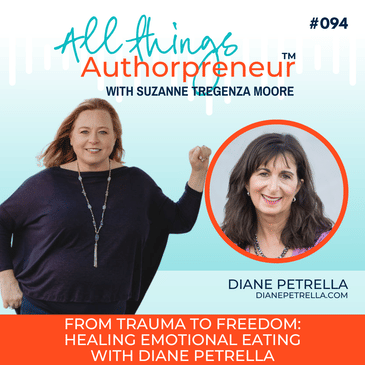
Join us on this enlightening episode as we sit down with Diane Petrella, MSW, a renowned clinical social worker and holistic licensed psychotherapist. With more than four decades of experience, Diane shares invaluable insights from her book, "Healing Emotional Eating for Trauma Survivors." Discover how to calm your anxious brain, cultivate self-compassion, and release the weight of past trauma to live with greater freedom and vitality. Tune in for transformative guidance on nurturing a peaceful relationship with your emotions, body, and food.
Guest
Diane Petrella,
dianepetrella.com
Highlights
In this episode we discuss:
· The strong link between trauma, abuse, and emotional eating
· Insights into trauma-informed practices for nurturing a peaceful relationship with food and emotions
· The difference between big 'Ts' and little 'Ts' and why they are both important to observe.
Book
Healing Emotional Eating for Trauma Survivors
Free Gift
5 TRAUMA-INFORMED TIPS TO HEAL EMOTIONAL EATING
Recommendation for Every Entrepreneur
If you love what you do, that makes all the difference.
Favorite Book
Autobiography of a Yogi by Paramahansa Yogananda
Spiritual Growth: Being Your Higher Self by Sanaya Roman
Links in this summary may be affiliate links.
[00:00:00] .
[00:00:25] Hello, Authorpreneurs. It's Suzanne Tregenza Moore and I am here with Diane Petrella.
[00:00:32] She is a clinical social worker and holistic licensed psychotherapist specializing in the effects of childhood trauma and emotional eating.
[00:00:43] Early in her nearly 40 year career, she co developed the first child sexual abuse treatment program in Rhode Island and was a forensic expert witness for sexual assault cases.
[00:00:56] Diane has helped thousands of people overcome early trauma, create a respectful relationship with their body and food and connect with their inner wisdom for self healing.
[00:01:09] She is the author of Healing Emotional Eating for Trauma Survivors, Trauma Informed Practices to Nurture a Peaceful Relationship with Your Emotions, Body and Food.
[00:01:21] And Diane, I'm so delighted to have you here today to talk about your book and your work.
[00:01:28] Suzanne, thank you very much for inviting me. I'm delighted to be here.
[00:01:33] So before we get into the book, I want to talk a bit about your history with working with children who have been sexually abused.
[00:01:43] And I can only presume that that work helped you recognize the connection between trauma and the way it affects us later in life.
[00:01:55] Absolutely. I was originally trained as a child therapist in my social work program.
[00:02:02] I have a master's degree in social work at MSW and my focus was working with children.
[00:02:07] And the first job I had was in the outpatient department of a child psychiatric hospital.
[00:02:13] And it was to develop, along with another therapist, to develop a sexual abuse program.
[00:02:19] And this, you know, I've been working almost 40 years in my private practice.
[00:02:23] So this was in the mid 80s, early to mid 80s.
[00:02:26] When I think of that time period, it doesn't even seem that long ago, frankly.
[00:02:30] But I guess it is. And a lot of people really weren't talking about sexual abuse.
[00:02:34] I had also in my social work program during my clinical internships,
[00:02:39] worked with children who were presented with all sorts of emotional issues, including trauma and sexual abuse.
[00:02:46] So we developed this program and it was at a time where people were just really beginning to understand, number one, that this happens.
[00:02:54] Right. And that incest happens, you know, along with sexual abuse by people outside of one's family.
[00:03:01] So I did a lot of teaching and training.
[00:03:04] I was an expert witness, as you had mentioned, in the courts.
[00:03:08] We consulted with the Department of Social Services in Massachusetts, in Rhode Island.
[00:03:13] I'm in Rhode Island. Obviously, it's close to Massachusetts, the tiniest state Rhode Island being.
[00:03:19] And so early on, I saw the effects of trauma for a child and adolescence development.
[00:03:28] And a lot of the families I was working with parents who experienced childhood trauma and many of these families, you know, they perpetuated the abuse and pain that they experienced.
[00:03:40] So I worked both with children and adults.
[00:03:44] I primarily only work with adults now. About 20 years or so ago, I did stop, you know, little by little stopped working with children.
[00:03:51] And I see a lot of people and have over the years, people who experience some form, maybe not all sexual abuse.
[00:03:57] That's not the only focus of my work now, but certainly various forms of trauma and other kinds of adverse experiences
[00:04:05] that may have created some really difficult hurdles for children that may or may not be considered traumatic, for example.
[00:04:14] Although that's on a continuum. That's certainly on a continuum.
[00:04:18] I've heard just in terms of, you know, the word trauma, right?
[00:04:22] I've heard people refer to it as big T and little t.
[00:04:25] Like big T is something that everyone would recognize as a traumatic event or trauma that someone would have, i.e.
[00:04:32] sexual abuse, being in a car accident, you know, having someone close to you killed, you know, things like that, that everyone would recognize is traumatic.
[00:04:41] But then that there are also little t traumas, which are really about something that somebody else may not find to be traumatic.
[00:04:51] Maybe the way someone speaks to you in a moment or your reaction to something.
[00:04:56] But that to the individual who's experiencing it end up being very traumatic moments in their lives that they need to get over.
[00:05:05] So I assume that's what you mean when you're saying a continuum.
[00:05:09] Exactly. That's exactly what I mean.
[00:05:11] And especially for children growing up in a situation where from the outside looking in,
[00:05:17] it may not look like trauma, but an emotionally unavailable parent, a divorce that even an amicable divorce may be experienced as trauma to some children.
[00:05:27] So, yes, that's exactly what I'm talking about. Big T and little t.
[00:05:30] Yeah. It is on a continuum.
[00:05:32] So let's talk about how those traumas, whether they're big or little t's, impact people in adulthood and how they interact with food and their body.
[00:05:45] Well, if during childhood you've experienced big T or little t trauma and it wasn't talked about or as with sexual abuse, for example,
[00:05:55] it's kept hidden and addictions that may have kept been kept hidden from the outside world.
[00:06:00] Sure.
[00:06:01] Especially when it's not acknowledged, validated, processed.
[00:06:06] And if a child doesn't have comfort for that, it gets encoded in the body.
[00:06:10] And it would anyway, even if they were able to talk about it.
[00:06:13] But even more so it's living in the body.
[00:06:16] And if somebody's never dealt with that, one of the things that happens in the brain, the brain is affected by those early experiences.
[00:06:24] And one significant way is that people later may become hypersensitive to stress, even in perhaps very low stress situations.
[00:06:34] But they may be hyper vigilant.
[00:06:36] Their bodies may react more easily to a stress heart rate heightens muscle tension, maybe a sense of shame can easily be experienced
[00:06:46] so that your body is like the receptacle for those physiological effects of early trauma.
[00:06:53] And it's particularly powerful when it hasn't been talked about.
[00:06:57] But I want to say here too, even when I saw many children where we did talk about what happened to them, they did have supports.
[00:07:05] You know that by no way would I think that that doesn't mean that when they get older or so for people listening to this,
[00:07:11] they may have had some some help along the way if they experienced a form of trauma.
[00:07:16] But it's an ongoing it may be an ongoing process.
[00:07:18] There's no set finish line, although absolutely people can heal and move forward and quote unquote get better.
[00:07:26] So when I said that, especially if it's not talked about, and that's part of what makes some traumas even more intense than not talking the secret keeping.
[00:07:35] So when somebody is triggered, their body may react, they may start feeling anxiety or panic or get shut down.
[00:07:42] And food or other substances may have been they may have discovered that that's a way to cope for children who have experienced trauma
[00:07:51] and they're just trying to cope in the best way they can, especially if it's family trauma and there's no escape.
[00:07:56] You don't tell on your parents. Some kids do as they get older, run away or talk about what's going on if it's family trauma.
[00:08:03] But in those situations until they may be old enough or older to get cigarettes or alcohol, which are self soothing, self medicating substances, food is readily available.
[00:08:16] Absolutely. Generally speaking, unless this food scarcity in a family, of course, sure food is available.
[00:08:22] It's easily accessed. You don't need a lot of money to go to the corner store to get something to get a bag of chips.
[00:08:28] So for many people that can become their first substance that they've discovered just helps them feel better.
[00:08:37] They may not even know how it helps them feel better, feels better, but it calms their nervous system.
[00:08:42] It may numb them out. It's a way to get through the day for some kids.
[00:08:46] Right. Right. I mean, sugar, right? A candy bar, a cupcake.
[00:08:50] I mean, the idea that they are feeling down or having, you know, they feel icky in some way.
[00:08:57] But when they eat that cupcake, suddenly they have more energy or they have more they're more excited about things.
[00:09:05] And I can completely see that. Absolutely.
[00:09:08] And it's a just it can be a distraction to whatever it is that they're thinking about or troubled by.
[00:09:13] And it sometimes can calm the anxiety or nervousness or panic in their body.
[00:09:19] And the same thing in adulthood, people discover that food helps soothe them, calms their intense emotions, helps them feel less overwhelmed.
[00:09:28] And it's also a distraction from whatever may be troubling them.
[00:09:32] Sure, absolutely. And I would think that particularly if someone was in a home where there was substance abuse, drugs or alcohol or things like that, and they're like, I'm never going to drink. Right.
[00:09:43] Because I there are people in my life who I love who grew up in that situation that they're like, well, we don't I don't drink because my you know, so and so is an alcoholic. Right.
[00:09:52] But boy, you know, they eat cookies like a lot.
[00:09:56] Right. Yeah, right. Exactly. It's another substance.
[00:10:02] It's another way to find something outside of oneself to feel better.
[00:10:08] And you experience how easy it is sometimes when you and I'm not saying it's an easy situation overall because it can create a lot of guilt and shame.
[00:10:18] But it's readily accessible and it's no blame around it.
[00:10:23] People want to feel better. And when you discover that certain kinds of food or a certain amount of food helps you feel better, you can do what you need to do to cope.
[00:10:33] Absolutely.
[00:10:34] You know, I often like to say to clients that there's nothing wrong with what it's not about what's wrong with you.
[00:10:40] It's that you're trying to cope with pain from the past that's emerging today.
[00:10:46] Yes. Yeah, absolutely. Well, and not only that, I mean, not for nothing, but people love to feed people.
[00:10:52] I mean, I'm guilty of this. Right.
[00:10:54] I love to make a batch of cookies or, you know, banana bread or a meal or whatever.
[00:11:00] And I love to feed people.
[00:11:02] And so if you are someone who is in that space anyway and you have people around you who love to feed you and love to bring you goodies, it's not helping.
[00:11:11] You know, I'd like to speak to that though. I don't it's food is love.
[00:11:15] The first experience children have of love is being held and cuddled and eating a bottle or the breast.
[00:11:23] Yes. And it's associated with love.
[00:11:27] And there's nothing wrong with wanting to feed people or bringing people food.
[00:11:33] And I'm not sure it means that it's not helping.
[00:11:36] You know, sometimes people will say, well, you know, growing up, if there was a holiday, we always had food or if I was upset, my mother would say, do you want ice cream?
[00:11:45] Well, let's sit in and of itself. There is nothing wrong with that.
[00:11:49] Yeah. The problem is, say, talking about childhood is if the child is struggling and they're sad and they're upset and there's nobody there to talk with them about it.
[00:12:00] Yeah. And they're using food as a substitute. But when you have a parent, mom or dad or any parents sitting down and saying, you know what? You look sad. What happened in school today?
[00:12:10] Let's talk about it. You know, want me to hear? Let's have some ice cream together.
[00:12:14] The food is secondary to the comfort and nurturance that the parent is giving them.
[00:12:19] So in and of itself, I don't believe it's true that in some families where, oh, well, we only use food.
[00:12:25] If love was there and attention was there and support was there, food was extra.
[00:12:30] That doesn't cause an emotional eating problem, in my opinion.
[00:12:34] The absence of the support is what can create the problem. Yeah. Yeah.
[00:12:40] So you keep doing what you're doing. So I get to keep making banana bread and cookies is what you're saying?
[00:12:45] Yes, you could get. I keep making banana bread and cookies.
[00:12:51] Good, because I have some really good. And also it's up to other people to tell you if that's not helpful to them.
[00:12:56] That's not your job to figure that out either. Yes. Love it. OK.
[00:13:00] So let's move on to what made you decide that it was time to write a book and what that process was like for you.
[00:13:10] Sure. I've always wanted to write when I was a kid. I loved writing. I loved reading.
[00:13:16] So that's just always been there. But I made my career was being a social worker.
[00:13:22] And I learned that pretty early on, too. I knew what I wanted to be is I was very goal directed.
[00:13:27] So writing was secondary, although I wrote like articles and different things here and there and some kind of local not magazines, so much as newspapers, whatnot.
[00:13:37] So I had my career as that we just spoke about. And but I always knew I wanted to write a book, didn't really know what it would be.
[00:13:45] But then as far as this particular book and the path it took about 10 years or so ago, a friend of mine who's a nutritionist, she and I worked together in those early years of trauma.
[00:13:56] She was an astute nutritionist that knew that the people going to meet with her around binge eating or emotional eating issues had trauma in their past.
[00:14:04] So we worked together quite a bit. So at this time, she was working for a second membership site wellness weight release program that no longer exists.
[00:14:16] But she asked if I would be open to writing a monthly blog article.
[00:14:21] So I'm a non diet approach person. And in my clients, I don't endorse diets per se and diet culture and whatnot.
[00:14:30] So I wrote about spiritual aspects to releasing, as I call releasing weight and creating a respectful, supportive relationship with your body.
[00:14:39] So I wrote these mind, body, spirit kinds of articles and I got great feedback.
[00:14:45] So I started developing a website around that and a following free download at the time.
[00:14:52] It's different from from what I have now. And so I started developing a following and I knew, you know, I'm this is what I'm writing a book around.
[00:14:59] And it just started from being able to write these monthly blog articles that I wrote for a number of years.
[00:15:04] I don't remember exactly. So I started writing about what I know best, working with people who have experienced trauma.
[00:15:12] And certainly I've worked with people who are affected by trauma in a number of ways, not only emotional eating.
[00:15:18] But this was an outgrowth of those articles that I had written. And it took a long time.
[00:15:24] I just started. I worked with a couple of different coaches. I went to workshops.
[00:15:29] The writing part was fairly easy for me and I enjoy writing.
[00:15:32] And, you know, I went to college was around English literature and whatnot.
[00:15:36] And then I went to social work school. So the writing part wasn't really the issue.
[00:15:40] Really, there was no issue. It was just doing it and spending the time getting it done.
[00:15:44] Takes time and it took a lot of help.
[00:15:47] I did, as I said, go to courses on publishing and publishing for self-help in particular in health, mental health professionals.
[00:15:55] As I said, I hired two book coaches, one to help me write the book proposal.
[00:16:00] And then, you know, I discovered as far as its book writing journey, obviously when you do a self-help book, you don't write the whole book.
[00:16:06] You send in a proposal, which is huge, which is like a book. It's a big process.
[00:16:11] So I was working on the proposal, but for me, I found it was a little daunting to do it until I had more of an understanding about what was going in my book.
[00:16:20] So I put a hold on that and then I started writing a draft of my book.
[00:16:24] That's just for me, it was the better way to do it.
[00:16:27] So after I wrote the draft, I revisited the proposal, revamped that because things change as you're working.
[00:16:34] You know, it morphed into something a little bit different.
[00:16:37] Absolutely. And then when it was done, I sent it in to my first choice was New Harbinger Publications and they did not accept it the first time.
[00:16:49] However, the acquisitions editor or the first editor that looked at it, we really clicked and connected.
[00:16:56] She valued my work, my writing. I called her my book angel.
[00:17:02] So she and I worked together and we took a little break and then worked together to just revamp some things.
[00:17:08] And then it was accepted and I was thrilled.
[00:17:12] Excellent, excellent. I love it.
[00:17:15] And how long ago did the book come out and what has been the impact if you've seen any direct impact on your business?
[00:17:23] The book was published September of 23. So not that long ago.
[00:17:28] Sure.
[00:17:29] Six months, almost six months. Yeah.
[00:17:31] As a psychotherapist and given where I am in my career, I'm only working with former clients that would like to continue to work with me.
[00:17:41] I'm actually not open to new clients. I needed to cut down my practice as I was writing on the book.
[00:17:48] Sure.
[00:17:49] I do always want to be available for people who used to meet with me and want to resume therapy.
[00:17:54] Yeah.
[00:17:55] So, you know, if they can work it out in their schedule and our respective schedules.
[00:17:59] So I can't say there was an impact, but I wasn't looking to have an impact on my business.
[00:18:04] Frankly, I wrote this book because I genuinely wanted to reach people in a larger way.
[00:18:12] Yeah.
[00:18:13] And how it's helped my business, I guess, even though not really my business, I'll tell you how it's helped me is when I've heard from people about how impactful my book has been and reading some of the reviews on different reviews, but certainly on Amazon and either on my social media, Facebook or other places.
[00:18:31] That's been the most powerful impact. I'm very proud of the book. I'm happy about how it turned out.
[00:18:38] Somebody said this was one of my favorite things someone said.
[00:18:42] It's like having a therapist in a book because they really felt like I was speaking to them.
[00:18:47] And I thought, yes, that's exactly what I wanted. I wrote to it as if the reader is just sitting in my office and we're talking together.
[00:18:54] Yes.
[00:18:55] And that apparently has come through. And that to me is very thrilling.
[00:18:58] So what I do hope to do in terms of my business down the road, since I'm not really open right now to individual clients one on one, I am taking a little break in this regard.
[00:19:10] But I do intend to create an online program based on the book or like an online book clubs, for example.
[00:19:17] So I haven't conceptualized. I'm beginning to think of what that might look like, but that would be another way.
[00:19:23] I'll take the book and open it to other people who want some more hands on help, but without meeting with me individually.
[00:19:30] I love it. I can see how I mean you have a considerable career and I love the fact that you're in a place where you only take clients who you've worked with before to kind of continue the care with them.
[00:19:42] But I love that you have taken all this experience and put it into something in a way that you can share the experience with people and your incredible knowledge of the subject.
[00:19:55] So thank you because I'm sure I have no doubt that it's helped many people.
[00:20:01] You know, I know a lot of people really struggle with all kinds of trauma and how it affects them today.
[00:20:07] So thank you.
[00:20:08] Thank you. Thank you for saying that.
[00:20:10] Truly, it's felt that this book is the culmination of my, as I said, nearly 40 years as a psychotherapist.
[00:20:17] And everything in the book are things I've worked with my clients around.
[00:20:21] All the strategies, the processes I've developed, there are things I've used with clients.
[00:20:26] So they've been tried and true that way.
[00:20:29] And it is really thrilling for me to hear from people and I'll sometimes get emails and it's very heartwarming.
[00:20:37] It's very heartwarming. Yeah. Yeah.
[00:20:39] Well, I want to move on to ask you a few questions that I asked everyone who comes on.
[00:20:44] Yeah.
[00:20:45] And the first one is, do you think you'll write another book?
[00:20:50] I love to write so I'm not sure but I can imagine that I will at some point.
[00:20:56] Okay. Awesome. Second one is, you obviously have had your own business for a very long time serving people.
[00:21:04] And everyone who listens in has their own business in one way or another because if you're an author, you have the business of getting your book out there.
[00:21:13] As an entrepreneur, what is one thing that you feel every entrepreneur needs to do or have in order to be successful?
[00:21:23] I have a passion for the work that I do and I always have from day one.
[00:21:28] I started my private practice when I was 29 years old and that came from the hospital that I and my colleague at the time were working at.
[00:21:38] They were going to close the sexual abuse program and we said, we're not going to let this happen.
[00:21:43] Wow.
[00:21:44] So I was 29, quit a job. I never ever would have imagined doing that.
[00:21:50] It was very scary. But we started our own practice and sadly, trust me, we weren't at a loss of clients.
[00:21:58] No.
[00:21:59] It was so pervasive. So we worked with offenders as well, sexual abuse offenders.
[00:22:04] And that was one of the most gratifying things that I had done in terms of my work too and helping people that a lot of people look at, you know, with a certain level of disdain.
[00:22:15] But in any event, I would say, you know, when you I love what I do, I have a passion for what I do.
[00:22:21] So I don't know if that answers your question, but I think that's really what's helped me be successful.
[00:22:27] I love it. I have a drive that makes me, you know, I'll go the extra mile when I know there's something that's important for me to do.
[00:22:35] So there's always the nitty gritty. I can't really say, well, you've got to do this or social media that or I don't know.
[00:22:41] When I started, none of that was even there.
[00:22:43] Right. Yeah.
[00:22:44] You know, but I think loving what you do.
[00:22:48] Yeah.
[00:22:49] No, I think that answers it very well.
[00:22:51] And being authentic, being authentic, just be who you are.
[00:22:54] Don't try to be someone you're not.
[00:22:56] And that comes through with clients, with the world.
[00:22:59] But I truly believe if you love what you do, that makes all the difference in the world and get the information you need and all the other stuff.
[00:23:07] Sure. But don't try to fit into somebody else's box of what you think you're supposed to do just to follow through with somebody else's expectation or just to make a lot of money.
[00:23:17] I mean, the money for me came.
[00:23:19] But what was more important, I'm not saying money is not important.
[00:23:22] It is what was more important was for me to work with these clients and to work with children and try to make a difference in someone's life.
[00:23:30] Right.
[00:23:31] The money comes from the service.
[00:23:34] Absolutely.
[00:23:35] The money comes from the service. Yeah.
[00:23:37] Right.
[00:23:38] Love that.
[00:23:39] Last question.
[00:23:40] Yeah.
[00:23:41] What is your favorite book?
[00:23:44] Hmm. I'll tell you a book that's had a great impact on me.
[00:23:48] And that was Autobiography of a Yogi.
[00:23:51] Oh.
[00:23:52] And a lot of that by Paramahansa Yogananda, his life and his teachings.
[00:24:00] He started what's called the Self-Realization Fellowship in California.
[00:24:05] And I've listened to their lectures and I've never attended anything in person.
[00:24:10] So I've been meditating for a long, long time.
[00:24:13] I'm a holistic therapist.
[00:24:15] So while I'm traditional, very traditionally trained, I believe in the importance of accessing our inner wisdom, our inner guidance.
[00:24:25] And that's one book that helped me.
[00:24:27] In fact, he's one of the people I mentioned in I'm He's Deceased at this point, mentioned in my acknowledgments because that teaching and training.
[00:24:35] And I will mention another one, the work by Senea Roman who channeled She's Deceased just a few years back, channeled Orin.
[00:24:44] And the first book of hers I read was Spiritual Growth again by Senea Roman channel for Orin.
[00:24:50] She's also mentioned in my in my acknowledgments.
[00:24:54] So I may be traditionally trained and I believe in all the and use a lot of trauma informed evidence based practices.
[00:25:03] And I always believed for as long as I started discovering it within myself, the importance of bringing in this expanded awareness,
[00:25:13] whether you want to call your higher power, your inner wisdom, but that level of knowing that we all have, but we don't always nurture or access.
[00:25:21] And when someone's traumatized growing up, that's always there.
[00:25:25] But their belief in themselves and their ability to listen to their inner wisdom and their instinct can get pushed aside.
[00:25:32] Sure. Because they can't they're either told, well, what's happening isn't real or you can't mean that could be all of the discussion.
[00:25:38] But that would be those would be one or two books that have had an impact on my work.
[00:25:44] And I bring into my work with clients, not where I mentioned the books per se.
[00:25:48] I might sometimes, but part of what I do is help people connect with their inner wisdom.
[00:25:54] And I think that's as if not more important than any psychological strategy that I've learned.
[00:25:59] Awesome. I love it. I absolutely love it.
[00:26:02] I know that you have a mini course that will be available to your website and we will have in the show notes.
[00:26:09] We'll have a link. Do you want to share a little bit about that in case anyone wants to get a taste of your work and how you can serve them?
[00:26:17] Yeah, these are five trauma informed tips to heal emotional eating.
[00:26:23] So people who struggle with emotional eating and have experienced some form of early trauma,
[00:26:28] there are five tips that they will receive in an email format where I'm kind of checking in with them.
[00:26:34] So that's why I call it like a mini course from breathing,
[00:26:38] from creating a self care basket to different ways of looking at trigger foods so they can on my website.
[00:26:45] Or I guess obviously you'll have the link. They can download that and start a little program for themselves to get a taste of what's in my book.
[00:26:53] Love it. Well, Diane, thank you so much for being with me today.
[00:26:59] I really appreciate it. It has been a lovely conversation and a very informative conversation.
[00:27:05] And I want to just share the title of your book again, Healing Emotional Eating for Trauma Survivors.
[00:27:12] Trauma informed practices to nurture a peaceful relationship with your emotions, body and food.
[00:27:19] Thank you so much for being here. Suzanne, thank you very much for the invitation.
[00:27:25] It's been delightful to have met you and I loved our conversation today. Thank you very much.
[00:27:30] Likewise, thank you. And to everyone listening, I look forward to bringing you another episode of All Things Authorpreneur soon.
[00:27:39] Thank you for listening to All Things Authorpreneur.
[00:27:43] Head to allthingsauthorpreneur.com and get your free guide, Seven Success Principles, to shift from author to thought leader.