Episode Summary
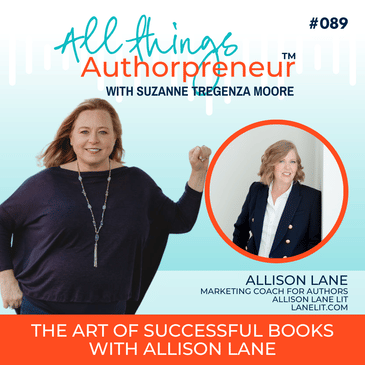
Allison Lane, an expert in guiding women through successful book publishing and launches. Whether you're an expert, PhD, podcaster, or memoirist, Allison's strategies can streamline your process and boost your book's success. Join us to learn about her proven paths to publication and impactful book marketing campaigns.
Guest
Allison Lane, Marketing Coach for Authors
Allison Lane Lit
lanelit.com
Highlights
In this episode you will learn:
- What key factors you need to make your book stand out and be marketable.
- Strategies for finding the right traditional or hybrid publisher
- How to effectively build an audience.
Free Gift
Step-by-step Guide – How to get a Book Deal
Recommendation for Every Entrepreneur
Have a plan, a roadmap of where you are now and where you want to end up.
Favorite Book
The English Patient by Michael Ondaatje
ADHD for Smart Ass Women by Tracy Otsuka
Links in this summary may be affiliate links.
[00:00:00] Writing a book can be the foundation for sharing your important message, but it won't
[00:00:07] work unless you are consistently marketing.
[00:00:10] This podcast is for those who have written a book to share their message with the world.
[00:00:15] I love talking all things authorpreneur and having guests join me to share their brilliance
[00:00:21] with you.
[00:00:26] Hello, authorpreneurs. It's Suzanne Tregenza Moore and I am so excited today to bring someone
[00:00:34] to your attention that I think you are going to want to know.
[00:00:38] Alison Lane helps women get their books published and launched successfully.
[00:00:44] From experts and PhDs to podcasters and memoirists, she helps authors save time, stay on budget
[00:00:52] and make their books a success.
[00:00:54] And before I get into speaking with Alison, I want to clarify that she is not a publisher.
[00:01:02] She helps people understand how to make their book marketable and write it so that their
[00:01:11] story is marketable.
[00:01:14] And I think that is so unique in among the people that I have interviewed and I'm
[00:01:21] so excited to have her here today.
[00:01:22] So Alison, welcome.
[00:01:24] Hi.
[00:01:25] Thanks for having me and thanks for advocating for all the people out there who know they
[00:01:31] have a book in them and yet they're spinning.
[00:01:34] This is the word that they use.
[00:01:36] I'm spinning.
[00:01:37] I'm getting so much advice.
[00:01:38] I don't know which way to move.
[00:01:41] Yes.
[00:01:42] Such a problem.
[00:01:44] Yes.
[00:01:44] And I think anyone who's ever written a book, ever thought about writing a book,
[00:01:49] you kind of have this thing in your head like, well, I know it's in me and I need to get it out
[00:01:54] and I need to share this information.
[00:01:56] And I know you and I know so many powerful women who've come through crazy things in life
[00:02:01] and it's made that it's given them knowledge.
[00:02:04] It's given them strength.
[00:02:05] It's taught them something and they want to impart that knowledge on others
[00:02:10] because they're like, gosh, I don't want anyone else to have to go through this.
[00:02:13] But having a good story isn't enough to make the book.
[00:02:21] I'll say for the book to have legs, is it?
[00:02:24] Well, no, unfortunately not.
[00:02:27] Your validity of your message, the power of your story, the value of your insights.
[00:02:35] None of that is enough to make your book marketable or to make your book a success.
[00:02:44] And that is because the publisher or even if you try it, if you self publish
[00:02:51] the reader that you know needs your message, you can't sell them your book
[00:02:58] by saying you really need this book.
[00:03:01] They need to understand your credibility.
[00:03:04] Why your message is something that they that has the answer that they need
[00:03:10] or that can remove the obstacle that's in their way.
[00:03:14] And that, my friends, is the marketing of your message.
[00:03:17] Just like if you run a restaurant, you can't sell the entree by saying
[00:03:23] you'll love the entree.
[00:03:24] You really, really need this.
[00:03:25] This is really, really good for you.
[00:03:27] I swear you're going to love it.
[00:03:29] No, that's not how it works.
[00:03:32] So whether or whether you're you want an agent or you want to go straight
[00:03:38] to a publisher or you're going with hybrid, you need to not just have
[00:03:44] a message or a story that the world needs because you know it does.
[00:03:49] You know that it's in there.
[00:03:51] Right.
[00:03:51] You need to be your book's very best marketer and be presenting
[00:03:57] the reasons why and the angles that deliver your message,
[00:04:02] the reasons why the world needs it.
[00:04:05] And it starts with knowing what the person out there who is your potential
[00:04:11] reader, what they want, what they want to get rid of and what's in their way.
[00:04:16] Yeah.
[00:04:17] So a lot of people come to you when they haven't even started writing yet.
[00:04:22] Right.
[00:04:23] And you help them not just figure out what they want to say,
[00:04:27] but how they want to package it in a way that people are going to say,
[00:04:33] oh, I want to read what you have to say.
[00:04:37] So where do you start with them in that process so that they have the greatest success?
[00:04:44] Most people when they know that they want to write a book,
[00:04:49] they've already done some writing and whether they have a successful
[00:04:54] psychology practice and they're running a therapy business or they're speaking
[00:05:01] or they're an expert because they're a professor and they teach PhD students.
[00:05:07] They know that there are people in the world who need what they have
[00:05:11] and they do an awful lot of let's call it content creation
[00:05:15] because they are sharing their methods and their storytelling
[00:05:22] and they're helping people.
[00:05:24] So they do quite a lot of helping and they know what works.
[00:05:29] So usually that is the impetus for them to think, well, maybe I need
[00:05:34] maybe an ebook to go along with my curriculum or to give my my patients
[00:05:41] something as a takeaway and that gets their wheels turning.
[00:05:46] When they come to me, they often say, oh, I've written half the book already
[00:05:50] as if that's helpful to me, which it's helpful to them
[00:05:55] because because it I mean, it is they've gotten they've put pen to paper
[00:05:59] and they've started to figure out, well, gosh, these are the elements
[00:06:04] that I want to share.
[00:06:05] So that is so useful.
[00:06:08] It's so useful when it comes to turning that into OK, how do I get a publisher
[00:06:14] interested providing more of the book?
[00:06:18] Isn't what publishers are looking for just like you can't if you're a restaurant
[00:06:23] tour, you can't say buy this, you know, come have dinner with us.
[00:06:28] Let me give you the entree for free so that you can
[00:06:31] you'll know if you're going to like the entree.
[00:06:34] Like, wait, what?
[00:06:35] You want me to eat the entire meal so that I know whether I want to come
[00:06:40] and eat the entire meal?
[00:06:41] That's not how it works. Right.
[00:06:43] So the publisher doesn't want to read your entire book
[00:06:46] to find out whether or not they want to publish your book.
[00:06:50] And this is particular to nonfiction because in nonfiction,
[00:06:54] you do not write your book first.
[00:06:56] You write your book proposal first. First interesting. OK.
[00:07:00] So do not write if you're writing nonfiction.
[00:07:03] Do not write your entire book and think you've done any one a favor.
[00:07:07] You haven't even done yourself a favor because the only thing you need
[00:07:11] in order to get published with a traditional or a hybrid publisher
[00:07:16] is a book proposal, which is a business plan for your book
[00:07:20] and two sample chapters. That's it.
[00:07:24] That's all. So instead of taking a sabbatical or waiting until you retire
[00:07:29] or whatever else or trying to fit it in in the wee hours of the night.
[00:07:33] You can not do that.
[00:07:36] And instead, it's a very straightforward process.
[00:07:39] What you asked was about, hey, do they write their all of their book?
[00:07:43] Well, they show up and they say, well, I've already written this.
[00:07:47] That is great because that gets them closer to what's the value
[00:07:50] that they provide in the world. Sure.
[00:07:53] But the next step is, OK, well, who are we speaking to?
[00:07:58] Who is this message for?
[00:07:59] What are they already inundated with? Right.
[00:08:02] What is old news to them?
[00:08:04] So doing that, that assessment of what's already out there,
[00:08:08] who's influencing them.
[00:08:09] And that's usually an eye opener of where the opportunities really are.
[00:08:15] And there are always some really impactful surprises during that process.
[00:08:21] I mean, that that process can take, you know, an afternoon, not a month,
[00:08:25] not a month, people.
[00:08:27] Please don't spend a month.
[00:08:29] Don't take a month. OK.
[00:08:30] I take a month.
[00:08:31] Let me ask you this in terms of your business and who you serve,
[00:08:35] what percent of the people you work with,
[00:08:40] would you say are really looking for that traditional publisher
[00:08:44] to publish them versus they are looking to possibly go with a hybrid model?
[00:08:52] And I know that you have thoughts about these sort of blending of those models.
[00:08:59] I'd love to have you share those thoughts with the audience.
[00:09:03] Sure. Well, it used to be in a world long, long time ago, maybe three years ago.
[00:09:10] But it feels like so long ago.
[00:09:13] It used to be that there were very particular definitions of types of publishers.
[00:09:20] There was the traditional, like the Harper Collins, let's call them the big guns,
[00:09:26] right, the big publishers.
[00:09:27] And they give in advance, they buy your book, they give you in advance.
[00:09:33] And then you go away for a year and you write the book and you deliver it to them.
[00:09:38] And then they publish it.
[00:09:40] And then there was a hybrid, which there was some sort of fee anywhere
[00:09:47] from 2000 to say 15,000, depending on the size of the press
[00:09:53] and how much marketing they do.
[00:09:56] And that fee covers things like paper and the editing that they're going to have to do.
[00:10:03] And then they still distribute, they still do everything on the back end
[00:10:07] that the traditional press does, except you as the author make more profit
[00:10:13] than you would with a traditional publisher.
[00:10:16] So a traditional publisher might pay you two or three percent of the sale of every book.
[00:10:22] So on a twenty dollar book, you get a dollar or two,
[00:10:25] or you might be split profits with a hybrid press.
[00:10:30] So anywhere from seven percent to 25 percent, maybe even 50, which is great.
[00:10:37] Right. The thing is, hybrid presses now are there are big ones
[00:10:42] that are oftentimes bigger than a boutique traditional publisher.
[00:10:48] Right.
[00:10:49] And there is this blending now.
[00:10:52] And right on top of that, they're self publishing,
[00:10:55] which I don't necessarily work with because that means that
[00:10:58] there's no one holding criteria for the quality. Yeah.
[00:11:03] Right. And so that third party credibility is very helpful, I think.
[00:11:09] And working with people who are discerning, they have skin in the game.
[00:11:14] Whereas a self publisher is saying, sure, we'll publish your book.
[00:11:17] And then they that's a different ballgame. Right.
[00:11:21] Right. So it used to be hybrid and traditional were very different.
[00:11:26] And and there were a lot more traditional publishers
[00:11:31] that have lots and lots and lots of imprints kind of sub brands within them.
[00:11:35] Yes. Now, with traditional publishing, having so many layoffs,
[00:11:39] a lot of those people have gone out to start their own really small
[00:11:44] publishing houses, really small. Yes.
[00:11:47] And those have a different business model entirely,
[00:11:51] as well as hybrid presses now have a different business model.
[00:11:56] Now we're seeing so many more business models
[00:12:00] across types of publishers that have much lower advances.
[00:12:06] Yes. Like you might get an advance that's three thousand dollars period
[00:12:10] instead of what the movies with Linda would have.
[00:12:15] Like a million dollar advance that does not happen.
[00:12:19] Right. It does not happen because that means that the publisher
[00:12:22] thinks that they're going to make more than a million dollars
[00:12:25] from the sale of your book, which is unheard of.
[00:12:29] That's like the lottery and right.
[00:12:32] If you're not a member of the British Royal family, it's not happening for you.
[00:12:36] Right. Or last name Obama.
[00:12:38] Right. Yeah. And it's not happening.
[00:12:40] Right. And you also need to have your own marketing team in house.
[00:12:44] So good luck for you. Right. Yes.
[00:12:46] Hey, right.
[00:12:47] Instead, you could have a traditional publisher that is super small
[00:12:52] and you could get a three thousand dollar advance
[00:12:55] or you could have a hybrid publisher that charges you three thousand dollars
[00:13:00] and they do the exact same thing.
[00:13:02] And no matter what, you are your book's best marketer.
[00:13:07] You are in charge of your marketing.
[00:13:09] The book publisher does not do the marketing for you.
[00:13:13] They announce the book to the publishing world,
[00:13:16] but that doesn't get you closer to your reader.
[00:13:19] Right. So the difference now, I think is, you know,
[00:13:23] it's like six and a half dozen.
[00:13:26] It doesn't matter.
[00:13:27] Whatever gets your book closer to the people who need your message
[00:13:31] is what I advocate for. Right. Right.
[00:13:35] That was a long way of saying it used to be very different.
[00:13:39] Now, I think the term hybrid is a misnomer.
[00:13:43] I think we need a different all inclusive.
[00:13:46] Right. And the reality is, is that if you haven't been already doing marketing
[00:13:52] and building an audience for your book
[00:13:55] and you're really building an audience for your message previously,
[00:13:59] then you better get started as you start putting that book proposal
[00:14:04] together or writing that book because ultimately you're the one who needs to
[00:14:09] figure out who is going to buy it.
[00:14:11] There's nobody out there that's going to do it for you.
[00:14:14] Exactly. Exactly.
[00:14:16] And then that, you know, build the audience goal makes it feel so
[00:14:22] undoable for debut authors because they think, well, how do I build an
[00:14:27] audience? And all we mean there is share some of your message,
[00:14:33] some of your advice in places that actually you have to pitch or that
[00:14:39] aren't just free. So not, not just on your website or in your emails that
[00:14:43] you send from your email, but share on LinkedIn where people can opt in or
[00:14:50] not. You should pitch to some digital media, do some sort of guest blog,
[00:14:57] create a newsletter on Substack or on LinkedIn.
[00:15:02] The LinkedIn newsletters are a great way to share your insight on women's
[00:15:09] history or how, you know, science-backed research is now showing up in marketing
[00:15:16] books. I mean, these are great places and the byproduct of that is
[00:15:22] you build your audience.
[00:15:24] Right. And depending on what audience you want to build,
[00:15:27] maybe it's not LinkedIn, maybe it's TikTok or maybe it's Instagram or even
[00:15:31] Pinterest. Right? Like it's all about where you think your audience is really
[00:15:36] hanging out, right? But get out there and share your message in whatever way
[00:15:42] you're comfortable sharing it so that people can start to feel connected
[00:15:47] to your message and to what more you want to share.
[00:15:50] Right. People are looking for solutions and inspiration.
[00:15:55] Yes. And if you have that to give, people are seldom searching for the answer
[00:16:02] to their problem. They're usually searching, you know, like asking Google
[00:16:07] what to do about, you know, my misbehaving dog.
[00:16:10] They don't Google how to have a well-behaved dog. Right?
[00:16:16] You've got to put on your audience hat and use Google to your advantage.
[00:16:23] Spend five minutes and ask Google the same couple of questions that you know
[00:16:30] your reader is asking.
[00:16:34] The great thing is you don't need to spend more than five minutes.
[00:16:36] You know why? Because it's Google, right?
[00:16:39] It gives you the most relevant, the most searched for responses right away.
[00:16:45] Yes. So we're not in the National Archives.
[00:16:48] You don't have to go on a digital journey.
[00:16:52] Right. And deep dive, it comes right to the surface.
[00:16:56] You don't have to start like go to the library and use the micro-feesh or
[00:16:59] whatever that was when you and I were of that age.
[00:17:03] Researching we had to.
[00:17:05] Yeah. By the way, in my case with Google, it would be has my dog
[00:17:09] completed her training of me? That's how I'm just.
[00:17:14] I think that every time she gets me to give her something.
[00:17:17] Yeah. No, it's so true though.
[00:17:19] I mean, I'm amazed sometimes when I think of something obscure and I go, well,
[00:17:23] Google it and I start typing it in and it finishes typing it for me.
[00:17:27] And I'm like, really?
[00:17:28] There are enough people that have asked this question that it like it
[00:17:32] finishes the sentence.
[00:17:34] I mean, often it's something bizarre, right?
[00:17:36] And I think, oh, I'm going to get something random.
[00:17:39] No, no, I get the answer.
[00:17:41] Right. Yes. You are not alone.
[00:17:44] This is this is Google letting you know.
[00:17:46] Yes. There are there are other people out there.
[00:17:49] And, you know, one of the great things about those responses is that Google
[00:17:54] will give you if you scroll down three or four, it'll give you a little
[00:17:59] option that says people also ask.
[00:18:02] Yes. And a lot of people don't know this.
[00:18:04] That is a great way to find out the language that people are using
[00:18:10] so that you can use the same language when you then share your content.
[00:18:16] If this is your problem, here are three things you can think about or what not
[00:18:22] to do when you're trying to determine whether your dog has finished.
[00:18:28] Finished training you.
[00:18:29] Yes. Yes. Exactly.
[00:18:31] Yeah. I love this.
[00:18:33] So before we move on to the questions I ask everyone who comes on,
[00:18:37] what I want to ask is a lot of our listeners,
[00:18:41] they've already written their book and it's already out there.
[00:18:45] If they are in that situation, but they're feeling like,
[00:18:50] this isn't really doing for me what I hoped it would.
[00:18:53] What do you do when people come to you and they're in that situation?
[00:18:57] Can you help them retrofit things a little bit?
[00:19:00] Or do they just need to write another book?
[00:19:03] Oh, Lord, that is such a bummer when someone thinks that their book launch
[00:19:08] was the beginning and the end of their book's life.
[00:19:11] It is not true.
[00:19:13] It's not true because of one thing that's a bummer to people.
[00:19:17] And one thing that is a boon is that when your book has a launch
[00:19:24] and you have been looking forward to this launch date for years,
[00:19:29] right, before you wrote the book, you're thinking about this.
[00:19:32] And then when you get the book deal, you're thinking,
[00:19:34] oh, this is my publishing date.
[00:19:36] My, for short, my pub date.
[00:19:39] Yes. This is the day.
[00:19:41] The bummer is no one is waiting outside the gates for the day
[00:19:48] than the book publishes.
[00:19:50] This is not like the opening of a Starbucks where people are so excited,
[00:19:57] like think heavens, now I can buy a five dollar cup of coffee.
[00:20:01] This is you're excited, but there's seldom is there a waiting audience for this.
[00:20:09] So your reader gets excited when they find out about your book.
[00:20:14] So if your book came out six months ago or a year ago and you now get introduced to them,
[00:20:22] they don't care. Right.
[00:20:23] This book is new to them.
[00:20:25] So if you if you think, well, my book, the launch didn't go that great.
[00:20:30] That launch is not a is a moment in time for you.
[00:20:33] But no one else is looking at it like that at all.
[00:20:38] Right. There are books that get slow starts and they keep chugging.
[00:20:43] And then suddenly the publisher is like, wait, we just got word
[00:20:48] that libraries are asking for this and they are befuddled just like you might be.
[00:20:53] But readers will react when you reach them.
[00:20:58] Right. So the worst thing you can do is treat your launch
[00:21:02] like some kind of sprint or even worse, a marathon,
[00:21:06] both of which sounds sweaty and horrible.
[00:21:09] And instead treat this like just part of your world.
[00:21:14] This should be a fun and exciting and it should work.
[00:21:20] All of your launch efforts, it's not just launching like a we're open now
[00:21:25] or launching like the space shuttle.
[00:21:28] It's done. It's not finished.
[00:21:30] What it means is the book is now available in libraries and bookstores
[00:21:34] and online. Yes.
[00:21:36] And it gives you so many options to show up where your reader already is,
[00:21:43] even when they're not thinking I'm a reader, like when they go to a conference
[00:21:46] or they're reading MSN online or they're listening to your podcast.
[00:21:53] They're thinking, gosh, I I've never heard of that book before.
[00:21:56] I can't wait to get it.
[00:21:57] They don't ask when was the publisher in date?
[00:22:01] Right. I don't know if it's still good.
[00:22:03] I mean, it's five months old.
[00:22:07] I guess that's old news.
[00:22:08] No, it's not.
[00:22:10] I mean, depending on what you're writing about, if you're writing
[00:22:12] about technology, it might be.
[00:22:15] But for most things that people write about,
[00:22:18] there is a much longer shelf life for that content.
[00:22:22] Right. And I have to say, I mean, how many people still recommend
[00:22:26] thinking Grow Rich, right?
[00:22:27] That is an old book at this point.
[00:22:29] But if you haven't read it, man, and you find that book and you read it,
[00:22:33] you're like, whoa, that was a good book.
[00:22:36] Right. And I learned a lot from that.
[00:22:38] Yeah. I love that message.
[00:22:40] Thank you so much for sharing it because I think as authors,
[00:22:44] we always need a little reminder.
[00:22:46] Yeah. Well, there are also cycles to book purchases.
[00:22:50] So more people buy books in fourth quarter
[00:22:55] of the year than in the first three quarters combined.
[00:23:00] Really? Really.
[00:23:01] So if you think that's very interesting,
[00:23:04] it's launched in May and it just is not selling as well.
[00:23:07] Like, well, you know, get ready.
[00:23:11] Right. Get ready.
[00:23:12] People buy books year round.
[00:23:14] And if you are not thinking about that or presenting
[00:23:19] or showing up in a big way when other people are actually looking around
[00:23:24] when they have money to spend, they're they actually go to the mall during that time.
[00:23:31] It's so true. I mean, you just said that.
[00:23:33] And of course, I'm in my brain thinking about when I buy books.
[00:23:36] Frankly, I buy the most books I buy like physical books are always for my mom
[00:23:42] and they're always for Christmas because every year she gets a pile of books
[00:23:46] from me for Christmas.
[00:23:47] And often it's like things I've read throughout the year
[00:23:50] or recently that I think she'll really appreciate.
[00:23:53] And I'm sure that drives a lot of that.
[00:23:56] I want to move on to a few questions that I ask everyone who comes on.
[00:24:00] OK, I don't believe that you have written your own book.
[00:24:05] Is that correct? That is correct.
[00:24:07] Is that something you intend to do?
[00:24:10] Do you have the bug?
[00:24:13] I do have the bug and yet the way that I started
[00:24:19] working to help authors bring their books into the world is that I went
[00:24:25] to a writing retreat and intent on writing my own book.
[00:24:30] And I ended up editing everyone else's books and their book proposals
[00:24:34] while I was at the retreat, so much so that the retreat
[00:24:38] with the woman who led the retreat started referring her clients to me.
[00:24:43] And when marketing is second nature for you because I have led PR
[00:24:48] in marketing for Fortune, for like Pepsi and Unilever and Birds Bees for 25 years.
[00:24:54] This is second nature to me.
[00:24:56] And it kind of took over my passion.
[00:25:00] And what I tell everyone is you have to decide what lane you're in.
[00:25:04] You can't move every project.
[00:25:06] You have one step forward when they're every project has 20 steps to go.
[00:25:12] It's true.
[00:25:13] And eventually I felt like, oh, my gosh, these women
[00:25:18] these books are never going to get into the world unless I clear a path for people.
[00:25:24] And it's part of my maybe part of my nature, but I feel like every book
[00:25:30] I'm a part of launching or a part of their publication.
[00:25:35] It's my success too.
[00:25:36] Absolutely. Yeah.
[00:25:38] It's not my name on the cover, but my name is in there.
[00:25:43] My thumbs are all my thumbprints are all over there.
[00:25:45] But I get an acknowledgement and also I'm helping people do something important.
[00:25:51] Yes, because women women particularly don't tend to take action
[00:25:56] until everyone else is taking care of.
[00:25:59] Yes. You know what?
[00:26:00] I love I love how you just expressed that because I feel I tell people all
[00:26:05] the time I feel so lucky to work with the people I work with every day
[00:26:11] because people who are writing nonfiction books are in some way trying to help or
[00:26:17] shape the world in a positive way and whether that is to individuals,
[00:26:21] whether it is a big lesson or whatever it is.
[00:26:26] Everyone I interact with is trying to be of service in their way.
[00:26:31] And that alone just being able to contribute to that.
[00:26:35] It feels so good on a daily basis.
[00:26:38] Exactly. I'm right there with you.
[00:26:40] Yeah, love that.
[00:26:41] OK, next question I have for you.
[00:26:43] You've been an entrepreneur for a while.
[00:26:46] You've had your own business.
[00:26:47] What do you think an entrepreneur has to do or have in order to be successful?
[00:26:54] Well, you do have to have a plan.
[00:26:57] A plan is a road map that shows where you are now and where you want to end up.
[00:27:06] The same as if you're going on a road trip.
[00:27:09] You can go on a road trip ever and ever and ever and never end up anywhere
[00:27:16] and still have been driving the whole time.
[00:27:19] But if you want to go from New York to L.A., you have to make a path.
[00:27:25] Yes, you don't necessarily have to go direct,
[00:27:29] but you do have to know where you want to end up, what success looks like for you.
[00:27:33] Yes. So as an entrepreneur,
[00:27:36] it's important that I know in the end where I want to end up.
[00:27:41] Love it.
[00:27:42] And I have to weave in the fact that my kids want to be fed every single day
[00:27:46] despite the fact. They are so annoying that way, aren't they?
[00:27:50] So frustrated.
[00:27:51] Oh, yeah.
[00:27:52] And at this point, their teenagers, they need so much food.
[00:27:57] The moment I clean up, boy, they are right back in there.
[00:28:02] Yes.
[00:28:03] So like digging around, I'm looking for something to eat.
[00:28:06] Like I am seriously just eight three chicken breasts.
[00:28:11] My son is 15. Yeah.
[00:28:12] So we I'm sure there are people nodding saying, oh, I am.
[00:28:16] Yeah, I am with you.
[00:28:19] I mean, there is a heart to heart connection here right now.
[00:28:22] Yeah, yeah.
[00:28:23] Chicken breasts can't get enough.
[00:28:25] So I have to weave in into my map that at a certain time every single day,
[00:28:32] I am despite the fact that I hate to cook, I hate to cook.
[00:28:36] And if anyone is out there thinking, oh, I'm I'm sure I could help you.
[00:28:40] Great. Get in touch.
[00:28:42] It's at Allison Lane, lit everywhere.
[00:28:45] I would love to hear from you.
[00:28:47] But I hate it.
[00:28:49] I have to drag myself to the kitchen.
[00:28:51] I have to spend time making sure that my kids eat things other than
[00:28:56] takis, which are like hot Cheetos.
[00:29:01] Like spicy hot Cheetos.
[00:29:03] Right. Right. Yeah.
[00:29:04] They're so perplexed when they eat an entire bag and they're like, I'm still hungry.
[00:29:08] And like, yeah, because you ate essentially air like a hot dust.
[00:29:12] Yes. An hour.
[00:29:14] Yes. Yeah.
[00:29:15] I have to weave that in.
[00:29:16] And if that means that I have to do fewer bigger things than great.
[00:29:23] I focus on making a bigger impact on fewer projects.
[00:29:28] Yes.
[00:29:29] That's what I know that I've done my job.
[00:29:32] I love it. I love it.
[00:29:34] Last question I ask everyone who comes on, what is your favorite book?
[00:29:38] Oh, my goodness.
[00:29:40] Well, can I have two?
[00:29:42] You may.
[00:29:43] OK. So in for fiction, I love the English patient.
[00:29:50] Even if you only read the very first page.
[00:29:54] Really? Yes.
[00:29:56] The very first page it is breathtaking.
[00:30:00] And the way the story you just plunge right into it and you have so many
[00:30:07] questions and every word is potent and filled with like intrigue and somehow
[00:30:15] raises so many so many red flags, you're like, oh my god, something bad happened.
[00:30:19] But how did we get here?
[00:30:20] And it's all on the first page.
[00:30:22] Wow. OK.
[00:30:23] My heavens. So yes, on the English patient.
[00:30:27] OK. And for nonfiction, particularly this year, ADHD for smart ass women is by
[00:30:36] far my favorite book.
[00:30:39] Interesting.
[00:30:40] Because it is funny, funny, funny.
[00:30:42] And it is the author is hilarious, has a podcast.
[00:30:49] But maybe you don't maybe you don't listen to podcasts.
[00:30:53] But if you know a woman or are a woman or your mother is a woman, then you
[00:30:58] probably know someone who has ADHD and it's probably undiagnosed.
[00:31:04] Right. ADHD was undiagnosed until I was
[00:31:08] like 48 and I'm 53.
[00:31:11] No idea.
[00:31:12] But after like pre menopausal or like postpartum women off and get hormones
[00:31:19] change and you end up with ADHD, you have no idea.
[00:31:22] And you're told like, oh, well, maybe it's just maybe you're just tired.
[00:31:28] Like maybe you're just tired.
[00:31:31] That's what I feel.
[00:31:32] So I think that ADHD for smart ass women, it's hilarious.
[00:31:36] It's unmasking just biases in medical research, but also empowering women to
[00:31:44] know how to manage finances and protect relationships and take something that used
[00:31:52] to be thought of as a negative and turn it into something positive.
[00:31:57] So I think that any book that can do all of those things is spectacular.
[00:32:01] Love it. Absolutely love it.
[00:32:03] Sounds like a great book.
[00:32:05] And I guarantee you, I know some women with ADHD.
[00:32:08] Oh boy. Yes. Yeah.
[00:32:09] Before we wrap up here, I believe that you have a gift for everyone in our audience.
[00:32:15] If they want to learn a little bit more about getting a book deal,
[00:32:20] would you like to share what that is?
[00:32:23] Yes.
[00:32:24] Oftentimes the biggest hurdle to getting a book deal is understanding the steps
[00:32:30] and avoiding taking massive detours.
[00:32:34] Sometimes those detours can be procrastinating or getting
[00:32:38] suckered into some class that is just you're spinning and you're thinking why?
[00:32:45] I and then at the end of the class, another step is revealed.
[00:32:50] And I don't love that kind of process.
[00:32:53] I'd rather give you the whole view of the roadmap.
[00:32:57] So if you're looking for a view of what the steps are, simple and clear,
[00:33:03] I provide you can go to my website and we'll have the link in the show notes.
[00:33:08] I'm sure. Yes.
[00:33:09] But get a step by step guide on how to get a book deal simple, easy so that you
[00:33:17] don't spend time swirling or going to a writer's retreat, which is essentially
[00:33:23] a vacation with people you don't know where you talk about books, but you don't
[00:33:27] necessarily move your nonfiction book closer to being in the world.
[00:33:34] Right.
[00:33:35] There are faster ways to do everything and I like speedy action and swift results.
[00:33:42] Excellent. Well, that sounds fabulous.
[00:33:45] I'm sure a lot of people will take you up on it.
[00:33:47] Alison Lane, thank you so much for being with me today and for sharing your
[00:33:54] knowledge of the marketing side of publishing a book and making sure that you
[00:34:02] have an audience for it.
[00:34:03] I know that everyone listening is going to find this really valuable.
[00:34:07] Well, it is my pleasure.
[00:34:09] And if there's one thing I can leave you with it is that for you, Suzanne,
[00:34:13] and for everyone out there, your book deserves to be in the world.
[00:34:17] And the people who truly are looking for you, they don't know where to find you,
[00:34:23] but you can find them because people look for their people.
[00:34:30] They self congregate.
[00:34:32] So they are always together and they are always banging a drum
[00:34:37] looking for the answers that you can provide.
[00:34:40] Yes.
[00:34:41] So just do the Google search.
[00:34:44] Ask Google what that person would ask and you will find exactly where they are.
[00:34:50] That's the first step.
[00:34:52] Love it. Getting your book deal.
[00:34:53] Love it. Well, everybody who's listening, you have gotten a lot of
[00:34:58] information out of our guest today, Alison Lane.
[00:35:02] And I hope that you've enjoyed it and I look forward to bringing you
[00:35:05] another guest very soon.
[00:35:08] Thank you for listening to All Things Authorpreneur.
[00:35:11] Head to iTunes and leave us a rating and review.